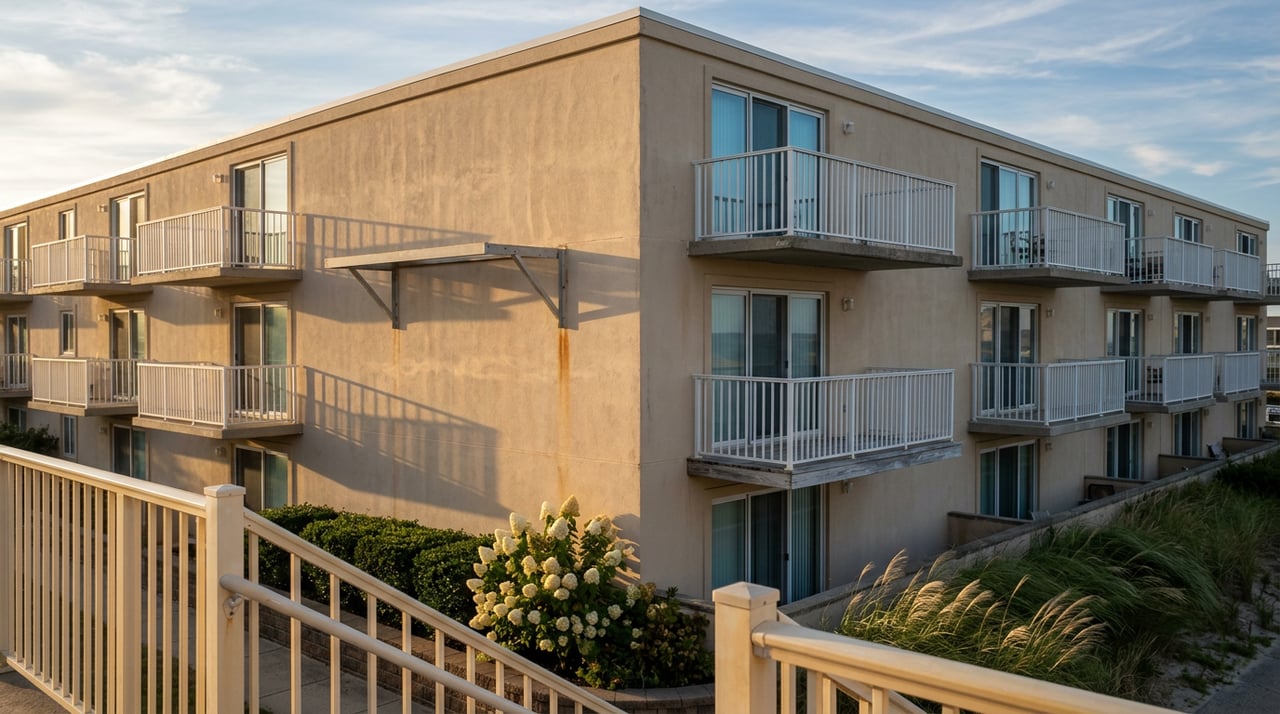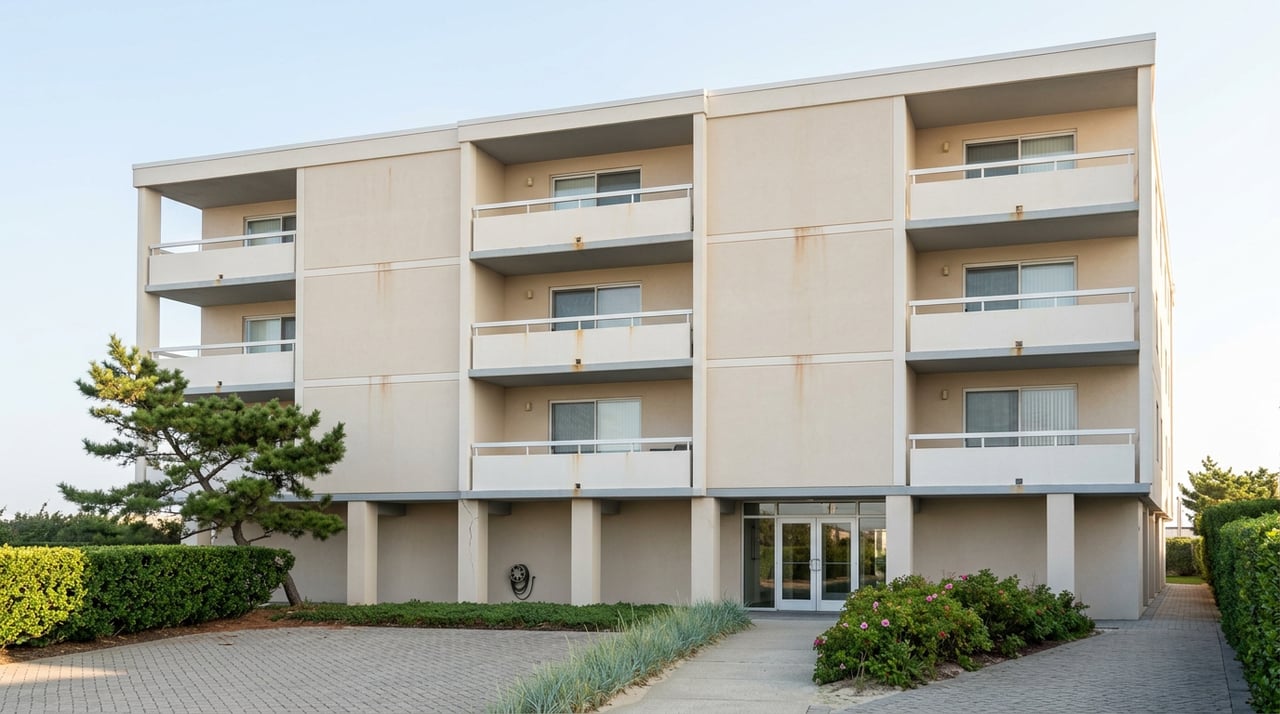
Ocean City's median condo price barely budged over the past year, holding close to $440,000 as of February 2026 based on closed sales tracked through Bright MLS. On paper, that reads as a market catching its breath after a few frantic years. Two buyers could look at that number, shrug, and assume pricing is roughly the same wherever they land on the island.
They would be wrong in a way that costs real money.
The median has gone quiet, but the condo fee attached to any given unit has not. Depending on which building you buy into, that fee can run anywhere from around $250 a month to well over $950, and the gap between a well-run building and a struggling one has widened sharply since 2022. A flat headline price is hiding a market that's actually splitting apart at the building level, and the split is driven by two things most buyers never think to ask about before they fall for a view: a state law that changed how condo associations have to save money, and an insurance market that has made saving that money a lot harder to do.
Same Median, Different Bill
Two condos can list at $425,000, sit two blocks apart, and cost their owners entirely different amounts to actually live in.
One might carry a $350-a-month fee because its association kept up with roof, elevator, and façade maintenance for two decades and already has the cash on hand the law now requires. The other might carry the same $350 fee today and a five-figure special assessment notice in the mailbox next spring, because the building deferred that same maintenance and is only now catching up.
The sale price tells you almost nothing about which one you're buying. The building's financial paperwork tells you everything. That's the part of an Ocean City purchase that's gotten harder to skip since 2022, and it's the reason a flat median doesn't mean a calm market underneath it.
Why This Wasn't True Two Years Ago
Two forces converged on Ocean City's condo stock at almost the same time.
The first was Maryland's House Bill 107, passed in 2022 partly in response to the 2021 Champlain Towers South collapse in Surfside, Florida. The law requires every condo association in the state to get an independent reserve study, an engineering-style audit of the building's roof, elevators, plumbing, balconies, and structure that estimates what those components will cost to repair or replace and when. Any association whose last study predated October 2018 had to get a new one, and once that study comes back, the association has three years to fund reserves to the recommended level and must keep them there going forward, with another update required every five years.
For buildings that had been quietly underfunding their reserves for years, often to keep monthly fees low and units easy to sell, the studies landed like a bill coming due all at once.
The second force was insurance. Coastal condo associations across Ocean City have seen master insurance premiums climb 40 to 150 percent since 2022, according to local property managers tracking renewals across dozens of buildings. One 28-unit association's history shows how fast that climbed: its multi-peril coverage ran about $39,000 a year in 2014, rose to around $60,000 by 2022, and passed $80,000 in 2023, with more increases expected in the years that followed. Wind deductibles moved in the same period too, from around one percent of a building's insured value to two percent in some renewals, which means the association absorbs a bigger chunk of any storm claim before insurance kicks in.
Put those two pressures on the same balance sheet and a building that could once absorb both with a modest fee bump now sometimes can't. That's when the special assessment shows up.
"I think it's a good thing, just for the fact being that it's finally got people's attention."
That's Cynthia Mooney, president of Shore Management, which oversees several Ocean City associations including La Mirage on 61st Street, Ocean Hideaway on 18th Street, and the Solara on 64th Street. She was talking about the reserve law after watching one 80-unit building she manages discover it needed $2.75 million to properly fund its reserve, a bill split among owners by unit size that worked out to roughly $58,000 for a three-bedroom unit. Her point wasn't that the law is painless. It's that buildings that had been coasting on artificially low fees for years finally had to show their real numbers, and buyers finally got a reason to ask for them.
What a Buyer Actually Sees on Paper
Fee levels in Ocean City now track location almost as closely as sale price does, based on closed condo sales from September 2025 through March 2026.
| Location Tier | Typical Monthly Fee |
|---|---|
| Bayside interior | around $351 |
| Ocean block | around $448 |
| Bayside waterfront | around $542 |
| Direct oceanfront | around $658 |
Direct oceanfront buildings run nearly double the fee of bayside interior properties, which makes sense given the added exposure to salt air, wind, and storm surge, plus the elevators, pools, and staffing that come with larger high-rise buildings. But that table only tells you the average. It doesn't tell you whether a specific building's fee reflects a fully funded reserve or a board that's about to ask owners for a lot more, quietly, in an executive session that hasn't hit the minutes yet.
The Fifteen Days That Matter More Than the Listing Photos
Once you're under contract on an Ocean City condo, Maryland law gives you a narrow but real window to find out which kind of building you're buying into.
Under the Maryland Condominium Act, the seller has to furnish a resale disclosure package no later than fifteen days before closing. That package should include the association's current budget, its reserve study, any unpaid assessments tied to the seller's unit, and any capital expenditures the board has already approved but hasn't yet folded into the regular budget. Once that package lands, you have seven days to cancel the contract without penalty if what you read changes your mind.
Seven days sounds like plenty until the package arrives as a hundred-plus pages of board minutes, financial statements, and engineering reports two days before a weekend. The buyers who use that window well aren't skimming for a big red flag. They're checking three specific things:
- Does the current year's budget actually match what the reserve study recommends, or is the association still contributing at the old, lower rate while the study says something higher?
- Do the board minutes from the last twelve to eighteen months mention insurance renewal shock, deferred repairs, or repeated owner questions about surprise costs?
- Is there a capital contribution fee attached to this specific sale, a one-time payment due at closing that funnels straight into reserves? These showed up on roughly nine percent of Ocean City condo sales between September 2025 and March 2026, and they're easy to miss if you're only looking at the sale price.
Lenders are paying closer attention too. In March 2026, Fannie Mae issued Lender Letter LL-2026-03, tightening its condo project review standards in coordination with Freddie Mac and the Federal Housing Finance Agency, specifically because projects with inadequate reserves put owners at risk of exactly the kind of surprise assessment Ocean City has been seeing. A building's financial health isn't just your problem anymore. It's your lender's problem too, which means it can affect what you're able to finance in the first place.
Reading the Building, Not Just the Unit
Not every Ocean City association got caught flat-footed. Buildings like Gateway Grand and Thunder Island are cited repeatedly by people who review these documents for a living as examples of associations that planned ahead, funded reserves on schedule, and kept owners informed well before a study forced their hand. Those buildings tend to carry fees that look higher on paper and cost less in practice, because the number you see monthly is the whole number, not a placeholder for a bill that's coming later.
The instinct to treat a low condo fee as a deal is understandable and often backwards. A fee that's stayed flat for years while insurance and construction costs climbed everywhere else isn't a bargain. It's usually a sign the board hasn't caught up yet, and when it does, the catching up tends to arrive as a lump sum rather than a gradual increase.
What This Means If You're Comparing Two Condos This Fall
A flat median price this year doesn't mean Ocean City stopped being a market worth watching closely. It means the differences that used to show up in the sale price have moved into the paperwork instead. Two units at the same number can carry completely different futures depending on whether their association read the reserve study seriously or filed it away.
If you're comparing buildings, ask for the reserve study and the current budget before you write an offer, not after. Ask whether the association's contributions match what the study recommends. Ask about the insurance renewal history, not just the current premium. None of that shows up in a listing photo, and none of it shows up in the median price everyone quotes. It's the actual number that decides what you'll be paying five years from now.
A Few Questions Worth Asking
Does a low condo fee always mean a better deal? Not by itself. A fee that hasn't moved much in a rising-cost environment can mean an association is underfunding its reserves rather than genuinely running efficiently. Compare the fee against the current reserve study, not just against other buildings' fees.
Can a pending special assessment affect my financing? It can. Lenders reviewing condo projects now look more closely at reserve funding and pending assessments following recent updates to Fannie Mae and Freddie Mac condo project standards. A building under a large pending assessment may face tighter financing conditions for buyers.
Who pays if an assessment is already approved before I close? That's negotiable between buyer and seller. The seller can pay the outstanding balance at settlement, or the two sides can adjust the purchase price to account for it. Either way, it needs to be addressed in writing before closing, not assumed.
If you're weighing two Ocean City buildings that look identical on the surface, that's exactly the kind of comparison the Sharon Daugherty Group works through with buyers every week, reserve study and all. Contact us before you write an offer, not after you've read the resale package alone at the kitchen table.