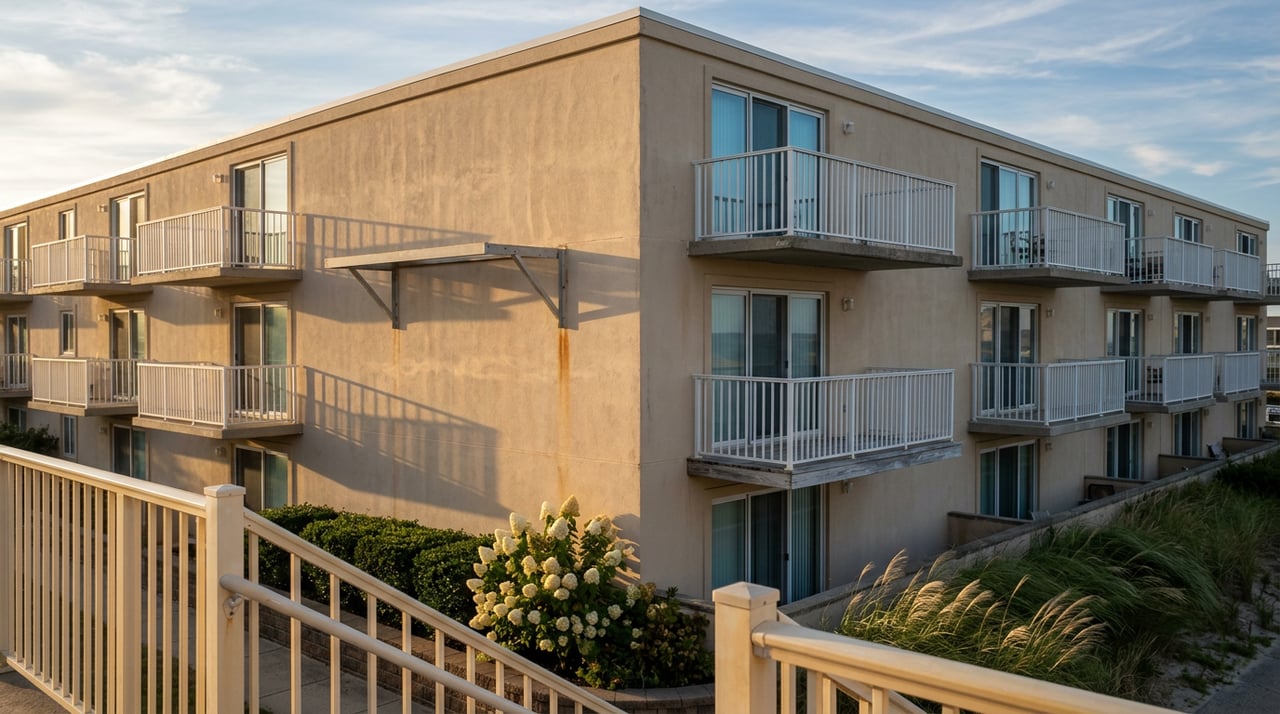
Walk the boardwalk past Rehoboth Avenue on a quiet September morning and you can still see the rust bleeding through the stucco on some of the older buildings, thin orange streaks running down from a balcony seam or a window ledge. Most people walk right past it. A structural engineer would stop and ask what's underneath.
That question is no longer optional in Rehoboth Beach. On June 8, 2026, the city's Board of Commissioners unanimously approved an ordinance that requires certain older, taller buildings to undergo recurring structural and facade inspections. It's the kind of policy that sounds like it should apply to almost everything built near saltwater. It doesn't. The way this law is written, most of the housing stock in town, including nearly every detached home a buyer might tour this fall, sits entirely outside it. The buildings that do qualify are a specific, identifiable slice of Rehoboth's older condo inventory, and knowing which side of that line a listing falls on is now a real due diligence question, not a curiosity.
What Commissioners Actually Passed
Corey Shinko, director of the city's Planning, Zoning and Development Department, introduced the ordinance in April and brought it back for a final vote in June. He described it as a property maintenance and public safety measure, not a zoning change. It doesn't touch use, density, height, or development rights. What it does is require buildings four stories or taller, or more than 50 feet in height, to enter a recurring inspection cycle: structural and load-bearing components checked at least every ten years, facades and balconies checked at least every five. A building enters the program 30 years after occupancy, or sooner if visible damage suggests a problem. Detached single-family homes are excluded by design.
Shinko put the reasoning simply.
"Older buildings can hide serious problems."
Mayor Stan Mills connected the ordinance to a specific vulnerability in Rehoboth's own building stock. The city's brick and concrete buildings absorb moisture, he explained, and the steel reinforcing those walls corrodes from the inside where nobody can see it until it fails.
The Building That Made the Case
Commissioner Mark Saunders didn't need to point to Florida to justify the vote. He pointed to the Sirocco Motel, demolished in the summer of 2025 to clear the site for the new One Rehoboth Hotel. When crews got into the structure, they found interior steel frames that had rusted away in spots, the kind of deterioration nobody could have caught by looking at the exterior. Saunders called it astounding. It's also exactly the scenario the new inspection cycle is designed to catch years earlier, before a building reaches the point where demolition is the only option left.
Why Fifty Feet Is the Number That Matters
Here's the detail that changes how a buyer should read this law: Rehoboth has spent decades making sure very few buildings would ever reach that 50-foot threshold in the first place.
In the 1970s, a developer built the Star of the Sea condominium on the boardwalk, a project residents and city leaders considered out of scale with the rest of town. The backlash led the city to cut its oceanfront height limit roughly in half. That decision, made half a century ago, is still shaping the market today. It means the buildings tall enough to trigger the new inspection ordinance are almost entirely older structures built before the height cap took effect, plus a handful of exceptions that predate current zoning. Nearly everything built since then, including most of the newer condo and townhome product marketed to today's buyers, was constructed under a height ceiling designed to keep it out of the ordinance's reach entirely.
That's the part worth sitting with. This isn't a law that spreads evenly across "condo ownership" as a category. It draws a hard line through the market, and the buildings on the wrong side of that line are disproportionately the older, boardwalk-adjacent properties that carry the most location premium and the most buyer interest.
What Falls on Each Side of the Line
| Building type | Subject to inspection program? |
|---|---|
| Detached single-family home, any age | No |
| Condo or multifamily building under 4 stories and under 50 feet | No, unless observable damage triggers early review |
| Older boardwalk-era condo building, 4+ stories, over 30 years old | Yes, structural inspection every 10 years, facade every 5 |
| Newer condo building built under the post-1970s height cap | Typically no, unless it happens to exceed 50 feet |
If you're comparing two condos in Rehoboth this fall and one of them was built before that 1970s height restriction took hold, that building is far more likely to already be inside the inspection cycle, or approaching it, than a comparable unit built more recently under the tighter height limit.
How This Compares to What Florida Buyers Already Know
If you've shopped a Florida condo since Surfside, some of this will sound familiar, because Rehoboth's ordinance was explicitly modeled on that response. Florida's statewide milestone inspection law applies to condo and cooperative buildings three or more habitable stories tall, triggered at 25 years for coastal buildings and 30 years inland, with a Phase 1 visual inspection and a more invasive Phase 2 if problems surface. Florida pairs that with a separate structural integrity reserve study requirement, meaning associations there also have to prove they've budgeted for the repairs the inspection might turn up.
Rehoboth's version is narrower on both counts. The story threshold is one story higher, the age trigger is a flat 30 years rather than 25 for coastal buildings, and there's no parallel reserve-study mandate written into the ordinance itself. That doesn't mean reserve funding is irrelevant. It means a Rehoboth condo association could pass a facade inspection and still lack the reserve balance to pay for what the inspection finds, and the ordinance alone won't tell you which situation you're walking into.
What to Ask Before You Write an Offer
A buyer touring an older Rehoboth condo now has a short, specific list worth working through before getting to contract:
- What year did the building receive its certificate of occupancy? That date determines when the 30-year clock starts, or whether it's already running.
- Has the building already completed its initial structural or facade inspection under the new program, and can the association produce that report?
- If no inspection has happened yet, is one scheduled, and who is paying for it?
- What does the association's reserve fund currently hold, and does it reference facade, balcony, or structural repair as a line item?
- Have commissioners' meeting minutes or association board minutes mentioned this ordinance by name? That's often the fastest way to find out if the topic has already come up internally.
None of these questions require a buyer to become an engineer. They just require asking the association for documents that, as of this fall, may not have existed a year ago.
A Few Things Worth Clarifying
Does this apply to condos under four stories? Not under the ordinance as written, unless a building shows visible damage that prompts an early review regardless of height.
What happens if a building fails its inspection? The ordinance requires professional evaluation and appropriate repair where deterioration is found. It does not require bringing an older building up to current code simply because of its age, so the scope of required repair is tied to what the inspection actually documents.
Is this the same as Florida's milestone inspection law? Related in origin, narrower in scope. Rehoboth's version applies to a smaller slice of buildings by height and story count, and it doesn't carry Florida's separate reserve study requirement.
Buying an older condo near the boardwalk isn't a problem this ordinance creates. It's a question this ordinance finally puts on paper. Knowing which buildings are inside that line, and asking for the paperwork that proves it, is the kind of groundwork that turns a good location into a good purchase.
If you're weighing a Rehoboth condo against a newer build, or trying to read an association's financials before you write an offer, Sharon Daugherty and the team can walk the documents with you before you're under contract, not after.